

FBB STATIONARY DATA SUBMISSION CHECKLIST
This checklist summarizes the steps described in the U.S. Fish and Wildlife Service's Florida Bonneted Bat Regulatory Survey Data Submission Protocol, an accompaniment to the Florida Bonneted Bat Consultation Guidelines. Highlighted text emphasizes required elements specific to Florida bonneted bat (FBB) regulatory surveys.

1
Start a New Project in NABat Partner Portal
1. Create a NABat User Account. Login to the NABat Partner Portal.
2. Under the My NABat tab, create a new project via the + Project button. This will open the NABat Project Wizard.
3. Use the following information to fill in the fields of the NABat Project Wizard. County codes for project name assignments and data processing can be found in Table 1.
Draft Project: CHECK THIS BOX. This prevents project information and data from being shared before final U.S. Fish and Wildlife Service approval.
Owning Organization: U.S. Fish and Wildlife Service
Collaborating Organizations: Leave blank.
Project Name: FBB_[YYYY]_[CNTY]_[Company]_[Name-of-Project]_[IPaC# - exclude if not assigned or known] Example: FBB_2025_BROW_IKC_Ficticious-Project_2025-0000001
Description: [Full company name] conducted a [survey type] survey for the Florida bonneted bat on behalf of [entity name] under [permit/contract identification]. [Describe project area and location (include acreage, mileage for linear projects, city, county, etc.)]. The survey entailed [brief description of survey]. This survey was [positive/negative] for Florida bonneted bat presence.
Study Area (Sample Frame): Continental US 10x10km Grid
Primary Intent of Data Collection: Regulatory Survey(s) (enter IPaC Project Code if assigned or known)
Initial Date of Data Collection / Final Date of Data Collection: Fill in the dates pertaining to your project.
Project Members: [Add the user “USFWS FBB Lead, FW4 (usfws_fbb_lead@fws.gov)” as a Project Leader] and other critical members of your organization.
NABat Data Use and Sharing Elections:
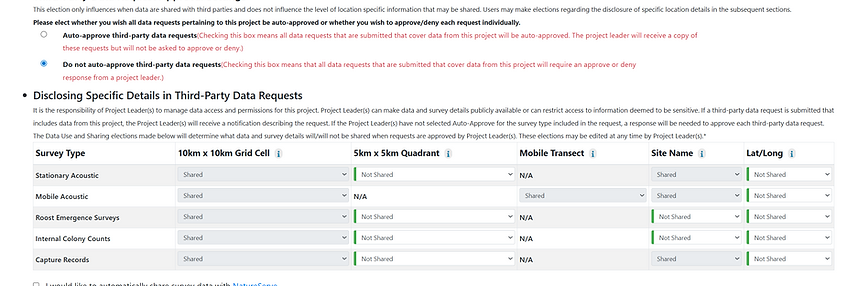
Do Not Auto Approve third-party data requests. For specific data use and sharing settings, refer to Figure 1. Ensure that editable selections for automatically sharing survey data are set to "Not Shared" and confirm automatic sharing with NatureServe and BatAmp remain unchecked.
Figure 1. Recommended NABat Data Use and Sharing Elections for FBB Regulatory Surveys. These settings are accessible while completing Project Members and Data section of the Project Wizard and should reflect the most conservative sharing options when available, i.e. "Do not auto-approve third-party data requests", and "Not Shared".
4. Verify project details are correct. Select Create Project.
COUNTY NAME | CODE |
|---|---|
Broward County, Florida | BROW |
Charlotte County, Florida | CHAR |
Collier County, Florida | COLL |
DeSoto County, Florida | DESO |
Glades County, Florida | GLAD |
Hardee County, Florida | HARD |
Hendry County, Florida | HEND |
Highlands County, Florida | HIGH |
Indian River County, Florida | INDI |
Lee County, Florida | LEEC |
Martin County, Florida | MART |
Miami-Dade County, Florida | MIAM |
Monroe County, Florida | MONR |
Okeechobee County, Florida | OKEE |
Osceola County, Florida | OSCE |
Palm Beach County, Florida | PALM |
Polk County, Florida | POLK |
Sarasota County, Florida | SARA |
Table 1. The 4-letter code for each Florida county within the distribution of the Florida bonneted bat. The 4-letter county code(s) are to be used when naming projects or processing data. In case counties outside of this list are surveyed for FBB (and/or have a confirmed detection), simply use first four letters of the county name, adding a “C” for the fourth letter when counties only have three letter names (e.g., LEEC = Lee County).
Select/Create a NABat Species List
1. Follow general guidance to Select/Create a Species List. FBB regulatory projects should create customized species list(s) based on Table 2 and not use the SAWG GRTS 1.0 species list(s).
Table 2. Species that fall within the distribution of the Florida bonneted bat (CORA = Corynorhinus rafinesquii; EPFU = Eptesicus fuscus; EUFL = Eumops floridanus; LABOLASE = Lasiurus borealis/Lasiurus seminolus; LAIN = Lasiurus intermedius; MOMO = Molossus molossus; MYAU = Myotis austroriparius; NYHU = Nycticeus humeralis; PESU = Perimyotis sublfavus; TABR = Tadarida brasiliensis). This table incidicates which species to be included in the NABat species list and in the species classifier used in automated identification, depending on the county within which the survey took place. Y = yes, include; (Y) = yes, include, uncommon/unlikely; N = no, exclude. Refer to Table 1 for full county name. Sources: USFWS 2019; USFWS 2021; Vannatta et al. 2021.
COUNTY | CORA | EPFU | EUFL | LABOLASE | LAIN | MOMO | MYAU | NYHU | PESU | TABR |
|---|---|---|---|---|---|---|---|---|---|---|
BROW | Y | Y | Y | Y | Y | N | (Y) | Y | Y | Y |
CHAR | Y | Y | Y | Y | Y | N | Y | Y | Y | Y |
COLL | Y | Y | Y | Y | Y | (Y) | (Y) | Y | Y | Y |
DESO | Y | Y | Y | Y | Y | N | Y | Y | Y | Y |
GLAD | Y | Y | Y | Y | Y | N | Y | Y | Y | Y |
HARD | Y | Y | Y | Y | Y | N | Y | Y | Y | Y |
HEND | Y | Y | Y | Y | Y | N | Y | Y | Y | Y |
HIGH | Y | Y | Y | Y | Y | N | Y | Y | Y | Y |
INDI | Y | Y | (Y) | Y | Y | N | Y | Y | Y | Y |
LEEC | Y | Y | Y | Y | Y | N | Y | Y | Y | Y |
MART | Y | Y | Y | Y | Y | N | Y | Y | Y | Y |
MIAM | N | Y | Y | Y | Y | (Y) | N | Y | (Y) | Y |
MONR | N | Y | Y | Y | Y | (Y) | N | Y | (Y) | Y |
OKEE | Y | Y | Y | Y | Y | N | Y | Y | Y | Y |
OSCE | Y | Y | Y | Y | Y | N | Y | Y | Y | Y |
PALM | Y | Y | Y | Y | Y | N | Y | Y | Y | Y |
POLK | Y | Y | Y | Y | Y | N | Y | Y | Y | Y |
SARA | Y | Y | Y | Y | Y | N | Y | Y | Y | Y |
2
Rename and Organize Acoustic Files
1. Each audio file needs to be uniquely named to allow for upload to the NABat Partner Portal. If audio files were not assigned a prefix prior to the start of surveys, the files should be renamed to match the NABat naming format (e.g. GRTSCellId_SiteName_Timestamp.wav). NABat provides R script for completing this process. To find the GRTS Cell ID of each site, use the NABat Grid Cell Finder.
2. Once audio files are properly named, organize raw files in a project folder with the same naming format used when naming your project (e.g. “FBB_[YYYY]_[CNTY]_ [Company]_[Name-of-Project]_[IPaC# if assigned and known]”). Individual deployments (i.e., single site, single detector, for a full passive recording period) should be in individual folders.
3. Place these raw data files in their corresponding “Raw” folder (Figure 2A).
4. Create a "Processed" folder within your project folder (Figure 2B). In the “Processed” folder, replicate the raw data subdirectories with empty folders of the same names (Figure 2B).
Figure 2. Example of subdirectories within a project folder. A) Within the “Raw” subdirectory is a folder for every individual deployment that contains the appropriate raw data (one site, one detector, one full deployment period). B) The user sets up a “Processed” subdirectory in the project folder and replicates the subdirectories of the raw data folders with empty folders of the same names

3
Processing Individual Survey Event Acoustics
1. Open Kaleidoscope Pro (KPro) and follow the steps listed in Processing Stationary Point Surveys. Additional guidance and information required for EUFL regulatory survey submission can be found below.
2. In the Batch tab of KPro, select a "Raw" data deployment folder as the single detector deployment for your Input directory. Your Output directory is the corresponding "Processed" folder. All data submitted for FBB regulatory surveys must be in WAV file format.
3. Proceed with guidance listed in Processing Stationary Point Surveys to embed required metadata to "Processed" .wav files. Additional specifications and information required for FBB regulatory survey submission can be found below.
FBB SPECIFICATIONS FOR EMBEDDING AUDIO FILES:
When embedding Survey Start/End Time metadata to audio files reference the beginning and ending detector activation time. If detector starts recording late, then start time should be listed as the date and time from the first file recorded. If a detector stops recording early (e.g., due to battery failure), the end time should be listed as the date and time of the last file recorded. Note such incidents in the Unusual Occurrences metadata field. Adjust times as necessary for each detector/deployment (i.e., do not just use the same full survey time for all batches unless detectors were all active for that full time). Use the formatting yyyy-mm-ddThh:mm:ss (e.g., “2020-07-15T21:30:00”). For Land Unit Code, use the first 4 letters of the county where the survey was conducted (same code as used in project name; see Table 1).
FBB SPECIFICATIONS FOR SIGNAL PARAMETERS:
Under the Signal Params tab, A = 8-120 kHz; B = 2-50 ms; C = 500 ms; D = 2, Figure 3 (this selection differs from typical NABat processing guidance)
Figure 3. The appropriate signal detection parameters to use when processing acoustic files in KPro for EUFL regulatory surveys. These include, A) 8-120 (KHz) Minimum and Maximum Frequency Range, B) 2-50 (ms) Minimum and Maximum Length of Detected Pulses, C) 500 (ms) Maximum Inter-Syllable Gap, and D) 2 Minimum Number of Pulses.
EUFL SPECIFICATIONS FOR AUTO ID FOR BATS:
Under the Auto ID for Bats tab, select Bats of North America from the Classifiers drop-down menu. Select + O Balanced (Neutral) (this selection differs from typical NABat processing guidance). From the drop-down menu at the top right and select Florida from the drop-down menu below the list of species. Manually add or remove species based on your survey's selected/created NABat species lists used for Auto Id and for Manual Id.
In KPro, files auto-identified as CORTOW represent calls from CORRAF, as these two species are considered acoustically indistinguishable (CORTOW does not occur in Florida). CORRAF is not an option in the Kaleidoscope species list, so CORTOW should be checked for data processing.
While Kaleidoscope includes both LASBOR and LASSEM as options for the species classifier, only select LASBOR for the KPro classifier. Files auto-identified as LASBOR represent calls that could be either of these two Lasiurus species, as they are considered acoustically indistinguishable. Including both species will result in a greater number of NoID files. When manually vetting for these species, you will use LABOLASE.
Before selecting Process Files, confirm the settings in the Signal Params tab are appropriate for EUFL surveys (Figure 3).

4
Manual Review of Acoustic Files
1. Projects are REQUIRED to manually review ALL wav files auto-ID'ed as EUFL for valid weather nights.
2. Projects are REQUIRED to manually review wav files auto-ID'ed as Noise or NoID where the characteristic frequency is at or below 20 kHz for valid weather nights.
3. NABat recommends projects manually review a minimum of one wav file auto-ID'ed to a given species per detector site per night, repeating for each assigned species for valid weather nights.
4. If you are reviewing acoustic file batches in full deployments (not night by night) for manual review, it is best to organize files within the KPro file viewer before manual vetting.
5. Open KPro and select File under the menu bar. Select Open Results and select your id.csv file of interest.
6. Timestamps should be included in file names. If so, click the Out File FS column and organize files from first recorded to last recorded. Next, click the Auto ID column title to group files by species and chronologically from first to last recorded.
7. Be sure to include Name of Species List used for Manual ID (it can be the same used for Auto ID, when appropriate) in your final metadata file if manual review was performed.
5
Create Metadata .CSV
1. Confirm all manual vetting/review is complete prior to moving forward with this step.
2. Continue to reference general guidance found in Processing Stationary Point Surveys and complete steps 12-17.
EUFL SPECIFICATIONS FOR CORYNORHINUS AND LASIURIDS:
Any acoustic files auto-ID'ed as CORTOW need to be corrected to CORRAF. To do so, open the metadata .csv via Excel and use the Find and Replace function (Ctrl + H). Enter CORTOW for Find what and CORRAF for Replace with.
Any acoustic files auto-ID'ed as LASBOR need to be corrected to LABOLASE. To do so, open the metadata .csv via Excel and use the Find and Replace function (Ctrl + H). Enter LASBOR for Find what and LABOLASE for Replace with.
The metadata .csv is now ready for upload.
6
1. Follow the guidance found in Adding Survey Data to a Project to load your survey metadata.
2. Projects are REQUIRED to submit metadata following NABat and USFWS FBB regulatory survey requirements for valid weather nights.
3. Projects are REQUIRED to submit wav files that have been auto-ID'ed as EUFL, for valid weather nights.
5. Projects are REQUIRED to submit all wav files auto-ID'ed as Noise or NoID where the characteristic frequency is at or below 20 kHz (range of EUFL vocalizations) for valid weather nights.
4. Projects are REQUIRED to submit wav files for all auto-ID'ed species, including NoID, for valid weather nights.
Upload Metadata and Acoustic Files
7
Nightly weather conditions for survey sites should be checked using the nearest NOAA National Weather Service station and summarized in the survey report per requirements listed in the Florida Bonneted Bat Consultation Guidelines.
Upload Weather Data
8
9
Complete Project Submission
To complete project submission, conduct QA/QC, upload other relevant project files, add any necessary project notes, and notify the USFWS of your completed submission.
ADD DEPLOYMENT + PROCESSING NOTES AND IMAGES:
1. Important notes about individual deployments should be added to the Comments field under the Deployment Details dropdown.
2. Important notes regarding data processing should be added to the Processing Notes field under the Echolocation Measurements dropdown.
3. Upload deployment images via the Upload Deployment Images button under the Echolocation Measurements dropdown.
Deployment images include photos of stationary acoustic detector setups, potential roost trees, cavities and other images relative to the individual survey event.
UPLOAD PROJECT REPORT (PDF) TO PROJECT FILES & EMAIL USFWS LEAD
If your project is related to regulatory consultation and compliance for the Florida Bonneted Bat, the final steps of project submission are to:
1. Upload a final project report (pdf) to the Project Files drop down under the Details tab of your project.
2. Confirm that the FW4 USFWS FBB Lead is included as a Project Leader of your project.
3. Email the USFWS FBB LEAD to notify them of project submission, attach a copy of the pdf report.
-
Successful submissions will receive an email from the USFWS FBB LEAD stating, "The USFWS Florida bonneted bat lead has reviewed this NABat project and has deemed data submission complete." This sentence will also be appended to the end of the project description in the Partner Portal.
-
The consultant/applicant's NABat user affiliation will then be changed to Limited - Read Only in all four permissions categories under the project's Details tab and draft status will be removed for the project.
-
Consultants/applicants are required to maintain a backup of the submitted project and its associated data for a one year minimum following successful completion of the regulatory FBB data submission/reporting process.

REMEMBER...
Manual Review of Wav Files for FBB Regulatory Projects
-
REQUIRED to manually review wav files auto-ID'ed as EUFL for valid weather nights.
-
REQUIRED to manually review wav files auto-ID'ed as Noise or NoID where the characteristic frequency is at or below 20kHz for valid weather nights.
-
RECOMMENDED to manually review a minimum of one wav file auto-ID'ed to a given species per detector site per night, repeating for each assigned species for valid weather nights (see top bullet for EUFL requirement).
Metadata and Wav File Submission for FBB Regulatory Projects
-
REQUIRED to submit metadata following USFWS FBB regulatory survey requirements for valid weather nights.
-
REQUIRED to submit wav files that have been auto-ID'ed as EUFL, any other bat species, or NoID, for valid weather nights.
-
REQUIRED to submit wav files auto-ID'ed as Noise where the characteristic frequency is at or below 20 kHz for valid weather nights.
-
RECOMMENDED to submit metadata regardless of weather conditions.
This page was last updated September 29, 2025. Refer to the Florida Bonneted Bat Consultation Guidelines for additional requirements for regulatory surveys. If you experience any issues while following these requirements, please reach out to the USFWS FBB Recovery Lead.